Slug_issue_18
Slug_issue_17
Slug_issue_16
Slug_issue_15
Slug_issue_14
Slug_issue_13
Slug_issue_12
Slug_issue_10
Slug_issue_10
9
8
7
6
5
4
3
2
1
See_all

Store

Invalid Format: An Anthology of Triple Canopy, designed in collaboration with Project Projects, is at once an archive of Triple Canopy's widespread publishing activities and a translation into print of projects that originally appeared in other forms. The design of Invalid Format reflects this problem: How might works produced for the screen be transposed to the codex in a way that recalls that former context, though not slavishly, and while also fully inhabiting the page? How can the form and function of interactive, audiovisual works be degraded elegantly, without disappearing entirely, in print? Invalid Format will be published at least annually, and will be available at select bookshops worldwide as well as on Triple Canopy's website.


Invalid Format: An Anthology of Triple Canopy, Volume 2
Published September 2012
Perfect-bound, 336 pp, 6” × 9”
Blue and black, gatefold cover
ISBN 978-3-943365-35-1
Design concept by Project Projects, layout and typesetting by Project Projects with Alex Lesy and Triple Canopy

$25

Select your region (prices include shipping)


Or receive Invalid Format when you become a Triple Canopy member.

The second volume of Invalid Format includes artist projects and literary work published from early 2009 through mid-2010, documentation of public programs, and a sampling of foundational correspondence. Contributors include Sophia Al-Maria, Bidisha Banerjee, Gil Blank, José León Cerrillo, Joseph Clarke, Joshua Cohen, Teddy Cruz, Ed Halter, Lucy Ives, Victoria Miguel, Joe Milutis, New Humans, Hassan Khan & Clare Davies, Karthik Pandian, Lucy Raven, Luc Sante, Nathan Schneider, Molly Springfield, Ben Street & the International Necronautical Society, Dan Torop, and Zs & Josh Slater. Distributed in North America by RAM Publications and in Europe via Invalid Format co-publisher Sternberg Press.

Invalid Format: An Anthology of Triple Canopy, Volume 1
Published January 2012
Perfect-bound, 336 pp, 6" x 9"
Black and white, gatefold cover
ISBN 978-0-9847346-0-3
Design concept by Project Projects, layout and typesetting by Project Projects with Alex Lesy and Triple Canopy

    $25
Select your region (prices include shipping)


The initial volume of Invalid Format includes artist projects and literary work published in the first year of Triple Canopy's existence, documentation of public programs, and a sampling of foundational correspondence. Contributors include Lene Berg, Joseph Clarke, Rivka Galchen, Adam Helms, Sheila Heti, Dan Hoy, the International Necronautical Society, Craig Kalpakjian, Jon Kessler, Wayne Koestenbaum, Rachel Mason, Amir Mogharabi, Rachel Owens, Ed Park & Rachel Aviv, the Poetic Research Bureau, John Powers, Emily Richardson & Iain Sinclair, Michael Robinson, and Diane Williams. Distributed in North America by ARTBOOK | D.A.P., New York, and in Europe by Motto Distribution, Berlin.

Corrected Slogans: Reading and Writing Conceptualism
Edited by Triple Canopy
Published by Triple Canopy and MCA Denver, January 2013
Perfect-bound, 268 pp, 4.5” × 7.5”
Black and white with one spot color
ISBN 978-0-9847346-2-7
Designed by Franklin Vandiver

    $15
Select your region (prices include shipping)


Corrected Slogans represents a vital discourse on conceptual practices in contemporary art and poetry. In conjunction with the exhibition “Postscript: Writing After Conceptual Art” organized by the Museum of Contemporary Art in Denver, the online magazine Triple Canopy hosted a series of public conversations between some of the most innovative artists and poets working today. The symposium “Poems for America” asked how conceptual strategies of writing have transformed conventional notions of expression. “Automatic Reading,” a seminar-style roundtable, focused on reading as a creative practice, and the book as a material object and social signifier. Corrected Slogans features annotated transcripts of these events along with contributions, new essays, artworks, and poetry from Nora Abrams, Andrea Andersson, Erica Baum, Franklin Bruno, Corina Copp, Michael Corris, Brian Droitcour, Jim Fletcher, Zachary German, Lucy Ives, Aaron Kunin, Margaret Lee, Paul Legault, K. Silem Mohammad, Ken Okiishi, R. H. Quaytman, Katie Raissian, Ariana Reines, William S. Smith, Mónica de la Torre, Gretchen Wagner, Hannah Whitaker, and Matvei Yankelevich. More than merely documenting discussions, however, Corrected Slogans activates the book as a site of creative production, enacting an expanded notion of publishing as a mode of critical inquiry. Distributed in North America by ARTBOOK | D.A.P.

The Binder and the Server
Published March 2012
Perfect-bound, 70 pp, 4.25" x 6.88"
Black and white
ISBN 978-0-9847346-1-0
Designed by Franklin Vandiver

    $10
Choose your region (prices include shipping)


We're pleased to announce the publication of The Binder and the Server, an expanded and illustrated paperback version of the essay by the same name, which originally appeared in the winter 2011 issue of Art Journal.

The Binder and the Server is the outcome of several group discussions among Triple Canopy editors, and was written by senior editor Colby Chamberlain. The essay details the history of Triple Canopy in order to stake out our position on the ideology of Internet culture. By carefully examining the history of new-media publishing and the shift from disciplinary to control societies, the essay addresses the politics of online identity, friendship, labor, and the dream of digital democracy. In short: On the Internet, we are all contractors.

This pocket-sized edition of The Binder and the Server, designed by Franklin Vandiver, draws on experimental paperbacks of the 1960s, chief among them the collaborations of Marshall McLuhan and graphic designer Quentin Fiore. The book is characterized by cinematic layouts that merge text, typography, illustration, photography, and original artwork by Josh Kline and Dan Torop.

The Binder and the Server expanded paperback was published with generous support from Franklin Street Works Press. In March, at the annual College Art Association conference, “The Binder and the Server” received the Art Journal Award for the most distinguished contribution to the journal in the past year.

Contact us for distribution rates.

Volume Number 2:
Miscellaneous Uncatalogued Material

Published March 2012
Set of three offset-printed, double-sided posters
23 x 16.5 inches each
Designed by Tiffany Malakooti

    $10


This publication emerges from a series of programs organized by Triple Canopy as part of the Museum of Modern Art’s Print Studio, a project initiated in conjunction with the exhibitions "Print/Out" and "Millenium Magazines." Print Studio explores the evolution of print-based artwork in recent decades, from the revival of traditional techniques to the employment of digital technologies. For Miscellaneous Uncatalogued Material, Triple Canopy asked Brooklyn-based artist, bookmaker and set-designer Sarah Crowner, Los Angeles native and Brooklyn-based artist David Horvitz, and poet Ariana Reines, author of The Cow, Coeur de Lion, Mercury, and the play Telephone and the translator of books by Tiqqun, Jean-Luc Hennig, and Charles Baudelaire, to each facilitate a public discussion of the relationship between certain objects in the MoMA collection and forms of communication and circulation fostered—or affected—by digital technologies. This is more or less what happened. The conversations were recorded, transcribed, edited, and annotated by Triple Canopy with the facilitators and participants, while being turned into three double-sided newsprint posters by designer Tiffany Malakooti.

Miscellaneous Uncatalogued Material is the second publication in Triple Canopy's Volume Number series, a publication cycle that reimagines the magazine as a framework for activities that occur beyond its pages. Publications take forms ranging from the broadsheet to the PDF to the poster and emerge from and feed back into discussions, workshops, and classes. Volume Number aims to be generative rather than documentary, absorbing these engagements rather than merely representing them. Instead of simply printing the work of artists and writers, Volume Number provides a variable space for Triple Canopy’s editors, collaborators, and audiences to think through the practice of publication, instantiating the public spaces magazines purport to produce in the world.

Here Comes Nobody: Essays on Anonymous, 4chan and the Other Internet Culture
By David Auerbach and Gabriella Coleman
Published March 2012
E-Book, 104 pp, 212 kb
Black and white
ASN: B007O13LI6

    $2.99


Here Comes Nobody, Triple Canopy's first e-book, features two essays published in the magazine in early 2012. Gabriella Coleman's "Our Weirdness Is Free" uncovers the logic of Anonymous—online army, agent of chaos, and seeker of justice. David Auerbach's "Anonymity as Culture" explores the online message board 4chan and the legacy of Internet masquerade in a treatise and a series of case studies.

Shadow, Glare
By Erin Shirreff
Published August 2010
Application, 442 kb
Requires Intel-based Mac, OS X v10.5 or later

Free Download

Artist Erin Shirreff’s motivation for developing Shadow, Glare, the first work she's designed for a digital environment, stems from those moments when the screen’s material presence becomes impossible to ignore, when dust accumulations, errant smudges, and the movement of shadows and glares disturb the illusion of transparency. "In my living room the light will shift," Shirreff explains, "and suddenly I’ll be looking at all the dust on my computer screen, or the splotches of light. That will really jar me back into my chair."

The Artist and the Economic Crisis
By Otto Freundlich
Annotated by The Editors
Published February 2012
PDF, 934 kb

Free Download

Published in conjunction with the exhibition Crisis and Critique, a video and audio-sculptural installation by Norwegian artist Per-Oskar Leu at 155 Freeman in February 2012. The exhibition considered the distance between historical truths and fiction, asking: What role can or should the artist play during watershed political moments?

This broadsheet, which was available in print throughout the exhibition, includes Freundlich's 1931 essay, as well as portions of the transcript of playwright Bertolt Brecht's appearance in 1947 before the House Un-American Activities Committee and photographs and film stills of various stagings of Brecht's plays.

Volume Number 1
Edited by Triple Canopy, Salon Populaire, and Bétonsalon
Published by Triple Canopy, November 2011
PDF, 9.6 mb

Free Download

Volume Number 1 consists of materials prepared by Triple Canopy, Salon Populaire, and Bétonsalon for ‘Simple Rational Approximations’, a curatorial programme organised by Artissima 18 in Turin from November 4–6, 2011. Featuring work by David Auerbach, Ellen Blumenstein & Daniel Tyradellis, Wayne Koestenbaum & Benjamin Tiven, Alix Rule & David Levine, and Caleb Waldorf.

Issue 16 Broadsheet
Published September 2012
PDF, 3.2 mb

Free Download

Featuring "Nineties" by Lucy Ives and "International Art English" by David Levine & Alix Rule, redesigned for print. Both pieces were originally published online in the sixteenth issue of the magazine.

Issue 15 Broadsheet
Published March 2012
PDF, 2.2 mb

Free Download

Featuring "Anonymity as Culture" by David Auerbach and "Call and Response" by The Editors, redesigned for print. Both pieces were originally published online in the fifteenth issue of the magazine.

Issue 14 Broadsheet
Published November 2011
PDF, 1.1 mb

Free Download

Featuring "The Sacred Prostitute" by Mina Loy with CF and "The Collected Lies of AK & All Sizes Fit One (For Peter)" by Aaron Kunin, redesigned for print. Both pieces were originally published online in the fourteenth issue of the magazine.


Rachel Harrison
where's my fucking peanut, 2012

Set of twenty-six 3-1/2 × 6 inch inkjet-printed cards and 32 wooden clothespins
Edition of 50, with 8 artist proofs and 2 printer proofs
Signed and numbered by the artist
Published by Triple Canopy

Currently sold out.

Triple Canopy is pleased to announce the publication of where’s my fucking peanut, a new limited edition created by artist Rachel Harrison. where’s my fucking peanut consists of twenty-six printed cards and thirty-two painted clothespins housed in a letter-pressed wooden case signed by Harrison. The text on the cards is scrawled in Sharpie and increasingly anxious in tone; each wonders about the whereabouts of a peanut allegedly stolen from an installation by the artist during an exhibition at the Right Bank, a Williamsburg bar, circa 1993. “Woe are peanutless days,” indeed.

Expanding upon an existing work included in Harrison's traveling survey, "Consider the Lobster," where’s my fucking peanut was conceived as the counterpart to her online project "Rump Steak with Onions," following its publication in the fourteenth issue of Triple Canopy. The article melds several stories of art and theft; among images of American entertainment legend Johnny Carson and a game of computer solitaire gone haywire, a body of evidence emerges.

Rachel Harrison lives and works in New York. She has shown throughout the US and Europe; her work was recently included in the 53rd Venice Biennale (2009), the Tate Triennial (2009), and the Whitney Biennial (2002, 2008). Her traveling survey, "Consider the Lobster," originated at the Hessel Museum of Art, Bard College (2009), and traveled to the Whitechapel Gallery, London (2010).

Special thanks to Carol Greene and Alexandra Tuttle for their support of this project. Additional thanks to Supreme Digital and Kelli Anderson for their expert printing services.


R. H. Quaytman
Light Industry, 2011

Archival digital pigmented print with silkscreen on Museo Max paper
12 3/8 x 20 inches
Edition of 30 with 5 artist prints, signed and numbered by the artist
Published on the occasion of the campaign to support 155 Freeman

Currently sold out.

R. H. Quaytman's work incorporates abstraction and layers of diamond dust, silkscreened photographs and hand-painted trompe l'oeil, personal and art-historical narratives. Her work is on view at this year’s Venice Biennale and has been shown at the Whitney Biennial (2010) and at solo shows at SF MoMA (2010) and Kunsthalle Basel (2011).


Matt Mullican
From Me (in Space), 2010

Archival pigment print
Diptych, each panel 17 x 22 inches
Edition of 30, signed and numbered by the artist
Published by Christine Burgin and Triple Canopy

    $450


For And Yet It Moves, the tenth issue of Triple Canopy, artist Matt Mullican collaborated with computer programmer Patrick Smith to create "Planetarium," a navigable scale model of the solar system. Mullican, who has worked in performance, installation, sculpture, and hypnosis, first experimented with digital environments in 1991 to create Five into One, a virtual city constructed in accordance with his personal visual vocabulary and cosmological order. Exploring that city, Mullican was transfixed by his ability to leave the earth's surface and travel into the sky, toward the stratosphere, into nothingness. (This experience of unbounded space became a leitmotif in later works.) From Me (in Space), an edition published by Triple Canopy as the companion to "Planetarium," is Mullican's schematic diagram of his relationship to space, positioning him both within and outside the solar system. The left panel of the diptych shows the planets, horizontally aligned and rendered as colored pixels in a black field, in the bright, solid palette characteristic of the artist's sculpture and cartography. On the right, Mullican charts his distance from those planets. Near the bottom of this panel, Mullican has provided a time stamp, halting the movements of these celestial bodies at the moment of his completion of the work.

Matt Mullican was born in 1951, in Santa Monica, California, and currently lives in Berlin. His work has been exhibited extensively in the US and internationally. Recently, his work was included in "The Pictures Generation, 1974–1984" at the Metropolitan Museum of Art (2009) and the 2008 Whitney Biennial; it has also been exhibited at the Drawing Center, New York (2008); Museum of Contemporary Art, Los Angeles (2005); Ludwig Museum, Cologne (2005); and Museu Serralves, Porto (2001). Mullican's work is currently the subject of a solo exhibition at the STUK Kunstencentrum in Leuven, Belgium, which will be traveling to de Appel, Amsterdam, and Haus der Kunst, Munich.

Triple Canopy
Erased Reflection (Screenshot), 2011
Two-color screenprint on paper
14 x 11 inches
Edition of 200 with 20 artists proofs, hand-numbered and signed on Recto
Printed by Kayrock Screenprinting, Inc., Brooklyn, NY
Created by the editors of Triple Canopy and published on the occasion of The Future Has Two Faces, a benefit for Triple Canopy, October 28, 2011.

    $30


Matthew Thurber
Impossible Geometries, 2010
Archival Risograph print
17 x 11 inches
Edition of 100, signed and hand-numbered on recto
Printed on the occasion of "Impossible Geometries," a benefit party for 177 Livingston, February 20, 2010

    $20

Dexter Sinister
A Skeleton, A Script, Or A Good Idea In Advance Of Its Realization, 2010
Risograph Print With Multiple Passes
12 x 9 inches
Edition of 100, hand-numbered on verso

Printed on the occasion of Triple Canopy's "Impossible Geometries," a benefit party for 177 Livingston, February 20, 2010.

One unpronounceable glyph: This print by Dexter Sinister is composed of six layers. Each layer consists of an individual character, printed in the following order: M, T, D, B, T, 2.

    $50

José León Cerrillo
Wrong Place, Right Time, 2009
Digital offset print
18 x 13.5 inches
Edition of 100, hand-numbered on verso

    $50

Sara Anderson (Sumi Ink Club)
Untitled, 2008
Silkscreen on paper
17 x 14 inches
Unknown Edition
Printed on the occasion of Triple Canopy's "LA Launch," June 27, 2008

Currently sold out.

Triple Canopy commissions artists to create media editions of video and interactive artworks originally produced for the magazine, public programs, and exhibitions. Each edition contains a signed certificate of authenticity, Blu Ray disc or DVD, and USB 3.0 flash drive, and is housed in archival packaging designed by the artists. For more information and pricing, please write to contact@canopycanopycanopy.com or call (347) 529-5182.


Boru O’Brien O’Connell
Adaptation after Metalogue (Part 1), 2012

Single-channel video with sound, 4:50 min loop
Edition of 4 with 2 artist proofs
Published by Triple Canopy

Triple Canopy commissioned Brooklyn-based artist Boru O’Brien O’Connell to create a new video based on the "Metalogues" of English anthropologist and linguist Gregory Bateson, featuring disjointed conversations between a father and daughter—thought exercises in which the dialectical structure of the exchange echoes the subject matter.

Boru O’Brien O’Connell is an artist based in Brooklyn. His work has recently been shown in solo exhibitions at LaMontagne Gallery (Boston) and group exhibitions at Marc Jancou Gallery (New York), Invisible Exports (New York), Soloway Gallery (Brooklyn), and Night Gallery (Los Angeles). He is currently working on a multichannel film installation with performance artist Miguel Gutierrez entitled And Lose the Name of Action, to debut at the Walker Arts Center and BAM in late 2012. O'Brien O'Connell's work has been featured in Triple Canopy, Bidoun, Vice, and Blind Spot, among other publications. He is a 2011 graduate of the Bard College MFA program. "State Changes," an interactive video project by O’Brien O'Connell, was published in the twelfth issue of Triple Canopy.


Per-Oskar Leu
Crisis and Critique, 2012

Single-channel video with two-channel audio, 27 min loop
Edition of 4 with 2 artist proofs
Published by Triple Canopy

Following “Crisis and Critique,” artist Per-Oskar Leu’s video and audio-sculptural installation for Triple Canopy’s Brooklyn venue in February 2012, and “Sixty-Five Years of Treason,” a re-imagining of that exhibition for audiences online, Triple Canopy commissioned Leu to create video edition of his multi-format project. All three iterations consider the distance between historical truths and fiction and ask: What role can or should the artist play during watershed political moments?

Taking as its point of departure German playwright Bertolt Brecht’s appearance in 1947 before the House Un-American Activities Committee, Crisis and Critique weaves together German films of the 1930s and 40s that dramatize the trial format. These include Fritz Lang’s M (1931) and Das Testament des Dr. Mabuse (1933); Brecht’s Kuhle Wampe, oder: Wem gehört die Welt? (1932) and Hangmen Also Die! (1943); and the film adaptation of Bertolt Brecht’s Threepenny Opera (1931). In combining archival recordings of the 1947 testimony with excerpts from period films, Leu investigates the Brechtian Verfremdungseffekt (“distancing effect”) as it relates to the playwright’s personal experience of this critical moment in American history.

Per-Oskar Leu lives and works in Oslo and New York, where he is currently attending the Whitney Independent Study Studio Program. His recent solo exhibitions include “Vox Clamantis in Deserto,” 1/9 Unosunove, Rome; “Part Thirteen,” Vanish, Frankfurt; “BFF,” Johan Berggren Gallery, Malmö, Sweden; and “Ideal Setting (with Fredrik Værslev),” Ping-Pong Gallery, Malmö, Sweden (all 2010). In 2009, he was commissioned by Frieze to create a site-specific work. Leu has studied at the Städelschule, Frankfurt (2008–2009), Glasgow School of Art (2006), and National Academy of Fine Art, Oslo (2002–2006). "A Forcing of Barriers," "A Forcing of Barriers," a related work by Leu, was published in the tenth issue of Triple Canopy.


Karthik Pandian
Sacrifice of the Banana, 2010/2012

Single-channel video with sound, 5:45 min loop
Edition of 3 with 2 artist proofs
Published by Triple Canopy

Karthik Pandian's video, originally published as an interactive media piece in the magazine's eight issue, is an ecstatic bestiary, a prequel to 2012. Shot by the temple police. Performed for the video camera. A film.

Pandian's practice seeks to unsettle the contradictions at the heart of the monument. The universal and contingent, sacred and profane, proximate and distant confront one another in his work. Concerned in particular with the way in which history lurks in matter, Pandian often uses 16mm film to excavate sites for fragments of political intensity. The sculptural works that support, enshroud and sometimes obscure his film projections are produced from materials drawn from his site research and assume the form of architectural constructions. Through moving image, sculpture and syntheses of the two, his work imagines freedom in relation to the impositions of architecture. For more on Pandian's work, see "Gatefold Equinox," an interview published by Triple Canopy.

Pandian has had solo exhibitions at the Whitney Museum of American Art, New York; Midway Contemporary Art, Minneapolis; White Flag Projects, St. Louis; and Vilma Gold, London among others. In 2012 his work was featured in the first Los Angeles Biennial at the Hammer Museum and La Triennale at the Palais de Tokyo. In 2011 Pandian was the recipient of a Louis Comfort Tiffany Foundation Award.

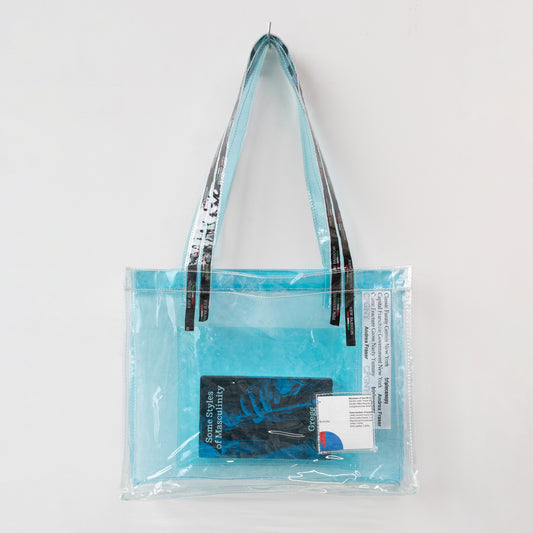
A Compact History of Digital Utopianism, from Bucky to Steve
Blue heavy-weight tote bag made from recycled bottles
Created on the occasion of Corrected Slogans*, a benefit for Triple Canopy, October 25, 2012

    $20
Choose your region (prices include shipping)

JF & Son Grid Tote
Limited-edition nylon and canvas bag with a full-length side pocket
Designed after Invalid Format: An Anthology of Triple Canopy, Volume 1
Created on the occasion of The Future Has Two Faces, a benefit for Triple Canopy, October 28, 2011

    $30
Choose your region (prices include shipping)

The Medium Was Tedium
Gray heavy-weight tote bag made from recycled bottles

Currently sold out.

Seven Translucent Tiers
Designed by Adam Helms (after Mel Bochner)
Gray heavy-weight tote bag made from recycled bottles

Currently sold out.

Not Nothing
The original Triple Canopy tote bag.

Currently sold out.